Q2 2026 was Lumera’s strongest quarter yet for on-chain activity and infrastructure growth — a period of consolidation after Q1’s Foundry Season 2 surge, capped by two of the largest technical milestones in the protocol’s history and a major new institutional partnership. The quarter in brief:
- EVM support went live on testnet (June 30). Lumera is now compatible with the full Ethereum developer stack — MetaMask, Solidity, Hardhat, Foundry — while keeping its Cosmos-native architecture and IBC. Ethereum reach without giving up what makes Lumera different.
- On-chain activity hit record highs. June recorded 275,278 transactions, the biggest month in Lumera’s history and up 114% over May. All-time transactions crossed 1.43M (+50% on the quarter).
- Staking nearly tripled. The staking rate jumped from 21.4% to 52.4%, with 163.74M LUME now staked — the largest single-quarter increase on record.
- The SuperNode fleet doubled, from 27 to 62 nodes (+130%), driven by the Cascade Everlight upgrade that now rewards operators for the data they retain long-term.
- Cascade reached production with Injective. Builders can now store application data – DEX order data, full app state, archiving – permanently on Lumera, unlocking genuine end-to-end decentralization. A LUKSO integration followed, and a third storage partnership is in its final stages.
- A major institutional partnership began. Lumera is now working with a leading institutional digital-asset platform providing full-lifecycle support — trading, liquidity, market making, custody, staking, credit, and exchange access — plus access to its wider ecosystem of AI-infrastructure networks. (Partner to be named in a joint announcement.)
- A new frontier opened: decentralized AI. Those introductions have started early discussions to bring Cascade (permanent storage) and Sense (provenance) to leading verifiable-AI and decentralized-AI networks.
Looking to Q3: EVM mainnet, the mainnet activation of Sense and Inference, a new community platform, centralized-exchange listings, and institutional-grade validators.
Lumera by the Numbers
A snapshot of real network usage and adoption for the quarter. These metrics track on-chain activity and protocol-level utility.
- Wallet Addresses: 159,813 (Mar 31) to 160,037 (Jun 30) (+224 / +0.1% QoQ)
- All-time Transactions: 952,123 (Mar 31) to 1,432,330 (Jun 30) (+480,207 / +50% QoQ)
- June Monthly Transactions: 275,278, highest single-month total in Lumera’s history
- Average Daily Transactions: 9,177/day in Q2 (vs. 2,453/day in Q1)
- Staking Rate: 52.39% (+30.96% QoQ)
- Total Staked: 163.74M LUME (largest single-quarter staking increase in network history)
- Total SuperNodes: 62 (+130% QoQ)
- Discord Members: 24,943
- Twitter/X Followers: 59,349
- Telegram Members: 4,453
- EVM Testnet: Live as of June 30
Business Development
Q2 delivered on two partnership announcements that the Q1 update flagged as priorities, began a relationship with a major institutional partner, and laid groundwork during the quarter that positions Lumera for a significantly broader ecosystem footprint in Q3.
Injective: End-to-End Decentralization, Live
The standout integration of the quarter — and the template for everything that follows — is Lumera’s partnership with Injective. In May, Lumera and Injective announced Cascade Phase 1, giving every builder on Injective the ability to store application data permanently and immutably on Lumera’s decentralized storage layer. NFT assets, DEX order data, and full application state are all supported from launch.
Why this matters: today, the overwhelming majority of Web3 applications run their logic on-chain but quietly store their data on centralized cloud infrastructure — a single point of failure that undercuts the entire premise of decentralization. The Injective integration closes that gap. For the first time, Injective builders have a credible, production-ready path to genuine end-to-end decentralization: decentralized logic and decentralized storage in one stack.
This is a live, growing integration, not a one-off press release. The teams are in active technical collaboration to expand Cascade’s availability across the Injective ecosystem, with a clear roadmap to Phase 2 and Phase 3 covering Sense (content verification) and Inference (AI compute). Cascade Phase 1 is the storage foundation; Sense and Inference layer verifiable provenance and AI compute on top of it.
The market response validated the model decisively. The integration announcement drove 18,842 impressions from Lumera’s own channel — the strongest single tweet since March — and a viral post from the Injective community added over 600,000 more. The deliberate three-tweet narrative arc (teaser, announcement, explainer) generated 31,698 of Lumera’s 62,252 total owned impressions for the quarter from that single sequence. This is now the proven playbook for every Q3 partnership announcement.
A Major Institutional Partnership
During Q2, Lumera began working with a major institutional digital-asset platform — one of the most established names in institutional crypto trading, liquidity, custody, and infrastructure, trusted by thousands of the world’s leading institutions. The partnership is live and the work is already underway. Lumera will share the partner’s name in a joint announcement in the near future.
The partner provides end-to-end support across the full protocol lifecycle — from liquidity design and treasury strategy, through mainnet growth, to institutional distribution and market access — including:
- Institutional trading and OTC execution across a universe of 400+ tokens and a network of 2,000+ institutional counterparties, supporting treasury management and large-block LUME transactions with minimal market impact.
- Market making across major centralized and decentralized exchanges, providing consistent liquidity, tight spreads, and healthier organic price discovery for LUME.
- Institutional-grade custody and staking — SOC 2-compliant, MPC-secured custody with segregated and insured assets, alongside validator infrastructure and staking support built for day-one readiness.
- Credit and lending, including financing against treasury assets and yield on idle reserves.
- Derivatives and treasury tools for managing token unlocks and optimizing treasury.
- Exchange-listing and distribution support, directly reinforcing the centralized-exchange listing initiative outlined below.
- Strategic venture and ecosystem support for the projects building alongside Lumera.
Just as important as the services is the access. This partner sits at the center of a large ecosystem of institutions and leading Web3 infrastructure projects, and the relationship is already opening doors that would otherwise take Lumera years to reach — including introductions to several of the most important networks in decentralized AI and verifiable compute (see below).
This is the institutional foundation Lumera has been building toward. It directly strengthens the two institutional priorities already underway this quarter — centralized-exchange listings and the onboarding of institutional-grade validators.
Expanding into Decentralized AI and Verifiable Compute
Through this institutional relationship, Lumera has opened discussions with several leading networks in decentralized AI and verifiable compute — precisely the category where Lumera’s storage and provenance layer is most differentiated. These conversations are early and none are finalized, but they point clearly at where Lumera’s capabilities are heading, and at the scale of demand Cascade and Sense can serve.
The common thread: these networks are exceptional at one thing — running AI, proving computation, producing models and datasets — but they share two structural gaps that Lumera is purpose-built to fill.
- Permanence. Most AI and compute networks optimize for short-term availability. The valuable artifacts they produce — datasets, model checkpoints, agent memory, inference outputs, audit records — have nowhere durable to live. Cascade provides permanent, content-addressed, integrity-verified storage: the long-term memory and audit archive beneath a compute network. (Cascade is live on mainnet today.)
- Provenance. These networks can prove that computation ran, but not whether an output is original, derived, tampered with, or identical to another. Sense fingerprints the artifacts themselves to establish originality, lineage, similarity, and tamper-detection — turning “where did this come from” into a verifiable claim. (Sense activates on mainnet in Q3 — see Technology Development.)
Two opportunities illustrate the direction:
A verifiable-AI compute platform. Lumera is scoping an integration in which its storage layer becomes the permanent memory and audit-archive tier for AI agents and applications — where autonomous agents hold long-term memory across sessions, and where every verified AI operation can be permanently archived and later audited. Sense adds a content-level provenance and compliance layer on top, a meaningful unlock for regulated buyers in finance, legal, and healthcare who need a durable audit trail.
A leading decentralized-AI network. Here the opportunity is a shared, permanent, cross-marketplace storage and provenance layer — a neutral home where the outputs of one AI marketplace become a trusted, verifiable product that another can consume. This enables cross-network data markets that do not exist today, directly addressing the data-quality and authenticity problems these networks face.
In both cases the model is the same, and it is proven: partners consume Cascade and Sense through a lightweight SDK and pay recurring, on-chain fees in LUME, generating structural demand for the token as usage scales. This is the same integration pattern already live with Injective, extended to the highest-value AI workloads in Web3.
Additional Ecosystem Partnerships
The LUKSO partnership followed in late May. LUKSO is focused on Universal Profiles and digital identity for NFTs and cultural assets, and Cascade will provide permanent, decentralized storage for NFTs and Universal Profiles across their ecosystem. Following the announcement, the teams hosted a live stream and demo showing Cascade integrated directly with LUKSO’s Universal Profiles, walking through real usage in their environment. Work is now underway to onboard additional developers and projects from the LUKSO ecosystem to build on Cascade. Third-party engagement from the LUKSO community drove over 546,000 impressions across partner channels, introducing Lumera to a large new audience outside the core Cosmos community.
Another ecosystem storage partnership is also in the final stages of agreement. Lumera will be providing Cascade’s decentralized storage infrastructure to this project, and the full details will be shared publicly once the agreement is finalized. The announcement is expected in the near term.
Governance, Listings, and Institutional Validators
On governance, the Lumera community passed Proposal #11 in April, updating the base fee for storing files on Cascade. The adjustment ensures that storage economics remain sustainable as network usage scales. It was the first governance vote where the community directly shaped Lumera’s economic parameters, and it passed with strong participation.
Centralized exchange listings remain a top priority for Q3. The team is actively working toward listings on Binance, Bybit, OKX, Coinbase, Gate, KuCoin, and Kraken. Each exchange has its own requirements around compliance documentation, market-making infrastructure, liquidity, and timing, and the team is progressing through those processes in parallel. No listing dates are confirmed yet, and Lumera will communicate publicly as individual agreements are finalized.
On the validator side, Lumera is in the final stages of agreements with institutional-grade infrastructure operators. These are not independent crypto-native validators but established global technology and telecommunications organizations, and their participation would mark a meaningful shift in the profile of entities securing the Lumera network. Details will be shared once agreements are signed.
Beyond the announced integrations, Lumera is in active discussions with a broad set of additional projects spanning EVM Layer-2 networks, Solana-native protocols, decentralized AI and compute networks, oracle infrastructure, zero-knowledge technology, cross-chain messaging, and identity and social protocols. None of these conversations are finalized, and Lumera will share specifics as individual partnerships are ready to be announced. The range of these discussions reflects what the EVM upgrade makes possible: Lumera can now engage credibly with builders across the full multichain landscape, not just the Cosmos ecosystem.
Technology Development
Q2 was a pivotal quarter for the protocol stack. Two major releases shipped, and the quarter ended with one of the most significant technical milestones in Lumera’s history going live on testnet.
v1.12.0 Aurora Zenith: Cascade Everlight
The headline release of Q2 was v1.12.0 Aurora Zenith, which went to testnet on May 19 and launched on mainnet on May 27. The core change was Cascade Everlight: a new economic model for SuperNode operators that ties ongoing rewards directly to the data they retain, distributed proportionally each payment period based on what they actually hold.
Before Everlight, storage economics were front-loaded. An operator received compensation when a user uploaded data, but had no direct financial incentive tied to keeping that data available over time. Everlight changes that. Operators who retain data longer earn more. Permanence is now backed by an economic structure, not just a protocol promise.
The practical effect is visible in the numbers. The SuperNode fleet grew from 27 nodes at the end of Q1 to 62 nodes by the end of Q2, a 130% expansion of decentralized storage infrastructure, as operators expanded capacity ahead of and following the mainnet launch.
v1.20.0: EVM Upgrade on Testnet
The quarter’s biggest milestone arrived on June 30 with the activation of full EVM support on Lumera testnet. Built on Cosmos EVM v0.6.0 with the x/evmigration module, the upgrade makes Lumera compatible with the full Ethereum developer stack while keeping the chain’s Cosmos-native architecture intact.
In practical terms: MetaMask works. Solidity contracts deploy. Hardhat, Foundry, Ethers.js, and Viem all connect. Any developer who has built on an EVM chain can now build on Lumera without learning a new toolchain.
The significance of this is in what it does not sacrifice. Most EVM chains achieve Ethereum compatibility at the cost of Cosmos interoperability. Lumera now offers both in the same chain: full EVM tooling alongside IBC, and Cascade, Sense, and Inference running underneath as purpose-built infrastructure for storage and AI compute. This positions Lumera to reach a substantially larger developer base while maintaining its differentiation as a specialized infrastructure layer.
For existing token holders, the upgrade introduces a one-time, fee-free account migration from the legacy Cosmos key format to the new Ethereum key format. Full migration documentation is available in the Lumera docs.
Transaction volume in June reflected the EVM upgrade clearly. Monthly transactions reached 275,278, a 114% increase over May and the largest single-month total in Lumera’s history. Average daily transactions reached 9,177, compared to 2,453/day at the start of Q2 in March.
Staking Surge
June also saw the largest single-month increase in staking in the network’s history. The staking rate moved from 20.6% at the start of June to 52.4% by June 30, with 163.74 million LUME now staked across the network. This coincided with EVM testnet activation and reflects renewed conviction from validators and delegators about the network’s direction.
As part of the v1.20.0 upgrade cycle, a portion of the validator set entered a transitional state while operators updated their configurations. This is a standard part of major upgrade processes, and the team is actively supporting operators through the migration. Active validator count is expected to normalize as the EVM rollout progresses.
Community Development
Q2 community development was defined by two major partnership announcements that brought significant new audiences into the Lumera ecosystem, a livestream and live demo with LUKSO, and ongoing work building the foundation for the new community platform launching in Q3. With the Injective and LUKSO integrations now live, Lumera’s community is growing beyond its Cosmos roots into EVM, identity, and NFT ecosystems.
New Community Platform
Q2 saw the completion of the bulk of development work on Lumera’s new community platform, which is set to replace the existing Zealy-based questing setup. The new platform is purpose-built around the feedback collected during Foundry Season 2 and is designed to deliver a significantly better experience for participants. An announcement is expected in the coming weeks, with a full launch to follow shortly after.
Partnership Content and Ecosystem Reach
Q2 was an exceptional quarter for earned ecosystem reach. The Injective/Cascade integration announcement drove 18,842 impressions from Lumera’s own channel on May 15, the strongest individual tweet since March. A viral third-party tweet from the Injective community added over 600,000 additional impressions. The LUKSO partnership announcement reached over 546,000 impressions through partner channels. Combined, the earned media from Q2 partnership announcements reached a larger audience than any single quarter of Lumera’s owned content history.
The content format that drove this performance was a deliberate three-tweet narrative arc: teaser, announcement, explainer. The Injective rollout followed this pattern precisely, and 31,698 of Q2’s 62,252 total owned impressions came from that three-tweet sequence alone. This is the format to replicate for Q3 partnership announcements.
Events and Broader Presence
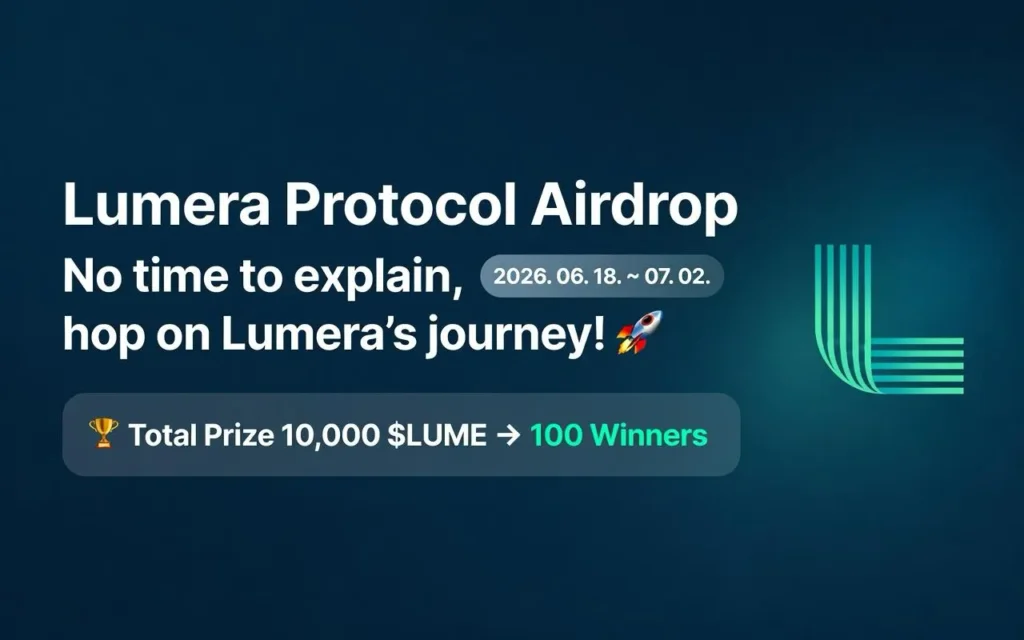
Q2 community touchpoints included Lumera co-founder Anthony’s participation in external panels on decentralized AI and blockchain infrastructure, validator-focused content around the v1.12.0 and v1.20.0 upgrades, and a regular cadence of technical posts that consistently outperformed promotional content with Lumera’s developer and validator audience. In June, Lumera also ran a special airdrop campaign for the Korean community in partnership with Xangle, expanding awareness in one of Web3’s most active regional markets.
On Twitter, the team maintained a quality-over-quantity content strategy through Q2, with technical milestone tweets and partnership announcements consistently outperforming promotional content. The EVM testnet launch on June 30 generated immediate engagement across Twitter, Discord, and Telegram simultaneously, with the validator operator notice for v1.20.0 reaching 4,256 impressions and the EVM launch tweet close behind. The EVM mainnet launch is the most significant catalyst for audience growth since mainnet, and Q3 content will be built around it.
Discord remained the core community hub through Q2, with #general accounting for the majority of conversation. Telegram showed strong responsiveness to major announcements, with activity rebounding sharply in June around the EVM launch and LUKSO partnership content. Both channels are expected to see meaningful growth as the new community platform launches and EVM mainnet creates fresh onboarding momentum in Q3.
What’s Ahead: Q3 2026
Technology Development
Q3 is the quarter where Lumera’s full modular stack is targeted to reach production readiness.
EVM mainnet launch is the headline milestone. With the upgrade live on testnet as of June 30, the Q3 focus is completing the validator and operator migration process, publishing comprehensive migration documentation, and launching EVM on mainnet. A full developer onboarding content series and ecosystem partner spotlights are planned alongside the launch to maximize reach into the Solidity developer community.
Inference and Sense, Lumera’s AI compute and content verification modules, remain on the roadmap for Q3 mainnet activation through the Lumera Hub. Both were targeted for testnet in Q2, and progress toward production deployment will be shared as it is ready.
Developer-facing initiatives including hackathons and ecosystem activations are planned for Q3 as the EVM launch opens Lumera to the broader Solidity developer community.
Business Development
Q3 is about accelerating the partnership model that proved effective in Q2. The Injective integration opened a clear framework: announce a concrete integration with a real technical use case, execute a narrative content arc around the announcement, and let the partner ecosystem amplify it. This is the playbook for Q3 partnership announcements.
Three priorities lead the quarter. First, deepening the institutional partnership — converting the relationship into concrete liquidity, custody, listing, and distribution outcomes. Second, advancing the decentralized-AI and verifiable-compute discussions opened through that relationship toward scoped Cascade (and, as it activates, Sense) integrations. Third, continuing to work with EVM- and SVM-based projects to position Lumera’s storage and compute layer as modular infrastructure that extends across ecosystems rather than sitting inside any single one. IBC compatibility and now EVM support give Lumera the technical foundation to pursue this positioning concretely.
Centralized exchange and DeFi integration work through Osmosis and Helix remains ongoing. On- and off-ramp access continues to be a near-term priority.
Community
The headline community milestone for Q3 is the launch of Lumera’s new community platform. Development is nearly complete, and the announcement is expected in the coming weeks. The platform is built around feedback from Foundry Season 2 participants and is designed to make ongoing participation more accessible, more rewarding, and more directly tied to real network activity.
A new questing and rewards platform is being developed to replace the current Zealy setup, with a significantly improved user experience based on Season 2 feedback. More details will be shared when the launch is ready.
With EVM mainnet on the horizon, Q3 community growth should also benefit from Lumera reaching a substantially larger developer audience. The EVM launch is the most significant new-audience catalyst since mainnet, and the content and community programs around it are designed to convert developer interest into active network participation.
About Lumera Protocol
Lumera Protocol is a high-performance blockchain purpose-built for AI-driven Web3 economies, integrating a Validator-SuperNode architecture to enable decentralized AI services, trustless computation, and secure data storage. Built on cometBFT Proof-of-Stake (PoS), Lumera ensures cross-chain compatibility, efficient AI data sharing, and scalable interoperability.
At its core, Lumera’s SuperNode-powered infrastructure extends beyond validation to support LLM hosting, autonomous agents, task verification, and cross-network communication, with governance driven by a stake-weighted system. Its adaptive tokenomics dynamically adjust inflation based on network participation, ensuring economic sustainability.
Lumera also introduces an Action & Agent Framework, powering decentralized AI services through specialized Actions (e.g., Cascade for storage, Sense for verification) and Agents (e.g., Inference for AI computation). By merging AI, decentralized computation, and blockchain security, Lumera sets a new standard for AI-powered applications and autonomous services in Web3.
For more information on Lumera, follow us on Twitter, Telegram, Discord and visit https://lumera.io.